

Have you ever wondered what spacecraft, rockets, and domestic large aircraft are made of? When I was a child, I always wondered why airplanes could fly in the sky. Back then, I naively thought that airplanes had some kind of magic power. Now I know they are made of special materials called **Aeronautical Materials**. Admittedly, my knowledge is limited, so today let’s take a detailed look at what aeronautical materials really are.
C919 successfully completed a long-distance ferry flight not long ago, and has captured the attention of the Chinese people.
"A generation of materials, a generation of aircraft", is a true portrayal of the history of world aviation development. Aeronautical structural materials are usually at the forefront of the materials field. Their high technical content and great technical difficulty show that they are worthy of being a member of the high-tech field, and worthy of being the " Day beloved child" of the materials world.
Recently, at the "Focus on New Materials - 2017 Smart Gather Shunyi" innovation-driven public lecture event organized by units including the Shunyi District Association for Science and Technology, Cao Chunxiao, an academician of the Chinese Academy of Sciences and materials scientist, gave a detailed account of several important "members" in the current aviation materials field.
One of the "Five Great Vajras": Titanium Alloy
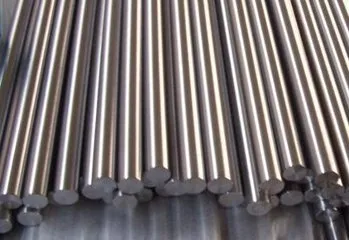
Flowers are blooming abundantly on the aviation site.
Titanium Alloy is an important structural material for large aircraft. Titanium Alloy has four major characteristics: first, it is resistant to High Temperature , second, it has a low density, third, it has high Strength , fourth, it has good corrosion resistance. Therefore, it is mainly used for important load-bearing components such as aero-engine blades and discs, engine pylons, aircraft landing gears, fuselage bulkheads, wing spars, empennage joints and other important load-bearing components.
Titanium Alloy The dosage in aircraft and their engines Continuous Innovation is high. Because the density of Titanium Alloy is much smaller than that of steel, while Strength is very close to that of steel, therefore, it can greatly reduce the weight of aircraft and their engines. In the early American Boeing 707 aircraft, the dosage of Titanium Alloy was only 0.2%, when it came to the Boeing 777 aircraft, the dosage of Titanium Alloy went Liter up to 7% to 8%. The dosage of Titanium Alloy in the fuselage of the Boeing 787 reaches 15%, setting the highest record for the dosage of Titanium Alloy in civil airliner fuselages.
Among the civil airliners developed in China, the Titanium Alloy usage of ARJ21 is 4.8%, and the Titanium Alloy usage of C919 reaches about 8%, which is comparable to the titanium usage of Boeing 777 and A380.
The dosage on American fighter jets and bombers Titanium Alloy continues to increase, and it reached a peak on the F/A-22, reaching 41%, setting the world's highest record for titanium usage in fighter jets so far.
The titanium usage in China's fighter jets is also showing a gradually Liter increasing trend: it is 2% for the J-8, 4% for the J-10, 15% for the J-11, 20% for the J-20, and as high as 25% for the J-31.
In China's Large military transport aircraft "Yun-20" (Kun Peng), the Titanium Alloy usage is 10%, which is comparable to the Titanium Alloy usage (10.3%) of the United States' advanced C-17 transport aircraft (Globemaster).
The aircraft with the largest titanium consumption in history is the SR-71 high-altitude High Speed reconnaissance aircraft (Blackbird), its titanium consumption reaches 93%, and it is known as the all-titanium aircraft. Its flight speed reaches three times the speed of sound, and its flight altitude reaches 30,000 Meter .
In the past 60 Year years, the overall trend of the usage of structural materials for aero-engines has gradually transformed from the era of steel and aluminum into the era of a "tripartite confrontation" of nickel, titanium and steel, with titanium dominating the cold section and nickel dominating the hot section. The future trend is that partial usage will be replaced by resin matrix, metal matrix, ceramic matrix composites and intermetallic compounds.
In China, the titanium usage of the Taihang engine reaches 25%, which is comparable to the titanium usage of advanced foreign engines. The titanium usage of the high thrust-to-weight ratio military engine being developed in China is expected to be 30% to 35%.
The Second of the "Five Great Vajras": Composite Materials
The development "wave" is surging.
In the late 196 Year s , High Performance carbon fiber achieved initial commercialization as a reinforcing fiber, and High Performance resin matrix composites reinforced with continuous carbon fiber emerged as the times require.
Since the 1970 Year s, the use of composite materials in the aviation industry has been continuously increasing. Traditional materials for manufacturing aircraft structures include aluminum, steel and titanium. The main advantages of composite materials are reduced aircraft weight and simpler assembly. Composite materials are also used to replace metal components on old aircraft.
Composite materials not only have higher specific strength and specific stiffness than Strength , but also facilitate overall structuring, thus significantly reducing the weight of aircraft structures (for example, the Boeing 787 has a weight reduction of 4500 Kilogram ), and correspondingly significantly reducing fuel consumption (for example, the Boeing 787 has a fuel consumption reduction of 8%).
In the first 10 Year of the 21st century, High Performance the two epoch-making milestones in the application of composite materials in aircraft are none other than Airbus' A380 aircraft and Boeing's "Dreamliner" Boeing 787 aircraft. Among them, on the A380, High Performance the amount of composite materials used accounts for 25% of the total aircraft structure usage. The integrated composite fuselage section of the Boeing 787 is the first highlight of the new generation Large aircraft material technology. The entire fuselage of the Boeing 787 is composed of several integrated fuselage sections, which reduces 1,500 parts and 40,000 to 50,000 connectors, significantly reduces structural weight, and greatly lowers manufacturing, assembly, operation and maintenance costs.
The development and application of new manufacturing technologies such as liquid composite molding and Automation layup have greatly promoted the expanded application of composite materials.
The amount of composite materials used in the airframe structure of some aircraft in our country is also constantly increasing. For third-generation fighter jets, it is 6% to 9%, for the new fighter jet J-20, it is 29% (already ranking first). For the military transport aircraft Y-20, it is currently 8%, for the commercial regional jet ARJ21, it is 1%, and for the trunk airliner C919, it is currently 12%. The amount of composite materials used in the new commercial turbofan engine under development is expected to be about 1%.
"The Five Great Vajras" Part Three: Superalloy
Enjoys the "crown" status in engines
Superalloy refers to a class of metallic materials based on iron, nickel, cobalt, which can work for a long time at high temperatures above 600°C High Temperature and under certain stress. They have excellent High Temperature Strength , good oxidation resistance and hot corrosion resistance, good fatigue resistance, corrosion resistance Fracture Toughness and other comprehensive properties. They are also known as "superalloys".
Superalloy was developed to meet the demanding requirements of modern aero-engines for materials, and has now become a class of irreplaceable key materials for the hot-end components of aero-engines.
In modern advanced aero-engines, Superalloy materials account for 40% to 60% of the total engine weight. On aero-engines, Superalloy is mainly used for four major hot-end components: combustion chambers, guide vanes, turbine blades and turbine disks; in addition, it is also used for components such as casings, rings, afterburners and nozzle exits.
The turbine disk of the F119 turbofan engine uses second-generation powder Superalloy , and the turbine blade uses second-generation single crystal Superalloy . The former is called the "crown" in an aeroengine, and the latter is called the "pearl on the crown".
China has also successfully developed single-crystal turbine blades and powder metallurgy turbine disks, and they have been successively applied in aero-engines.
"The Four of the Five Great Vajras": Aluminum Alloy
Constantly unveil its "magic weapon" for victory
The development of Aluminum Alloy in the United States was improved on the basis of 7075 (launched in the 194 Year s of the last century) and 7050 (launched in the 1970 Year s), and launched 7150, 7055 and 7085 alloys successively in the 1980 Year s, 1990 Year s and early 21st century of the last century. Improved on the basis of the first-generation skin alloy 2024 (launched in the 1930 Year s) and others, the second-generation skin alloy 2524 was launched in the 1990 Year s of the last century. Among them, 7150, 7055 and 2524 are known as the "three magic weapons" that the United States used to establish aviation Aluminum Alloy advantages in the late 20th century, while 7085 is the "latest magic weapon" that the United States used to expand its advantages in the 21st century.
The development of aluminum-lithium alloys has also improved the competitiveness of Aluminum Alloy .
The advent of 7085 has opened the way for the application of extra-large forgings on the A380. Existing high-strength Aluminum Alloy forgings or thick plates all have certain limits on thickness, for example, 7055 is limited to 38 Millimeter , although 7150 is more ideal, its thickness is also not allowed to exceed 120 Millimeter . In order to obtain high-strength Aluminum Alloy forgings or thick plates with larger thickness, the American Alcoa company created a patented 7085 Aluminum Alloy , due to its good hardenability and casting performance, its maximum thickness can reach 250 Millimeter . Extra-large beam die forgings made of 7085 alloy have been successfully applied to A380 Large passenger aircraft.
The Fifth of the "Five Great Vajras": Steel
still occupies an indispensable position
The advent of ultra-high Strength strength steel 300M, Aermet100, and S50 has continuously improved the competitiveness of steel.
The steel landing gear of American B737-300 and the Boeing series passenger aircraft launched after it basically all use 300M steel. American third-generation fighter jets also usually use 300M steel to manufacture landing gear, but the landing gear of the fourth-generation fighter jets F/A-22 and F35 began to use the newly launched Aermet100. Compared with 300M steel, Aermet100 not only Strength is a little higher, but also has much better corrosion resistance and damage tolerance, and also has better fatigue performance. However, to date, American civil passenger aircraft still have not selected Aermet100, the high price may be an important reason.
The Corrosion Resistance of S50 can be one order of magnitude higher than that of Aermet100 .
The key components such as the landing gear piston rod of our country's C919 passenger aircraft are made of 300M steel.
In the development process of the aviation industry, the speed of material upgrading is getting faster and faster, and materials and aircraft have been developing continuously under mutual promotion.
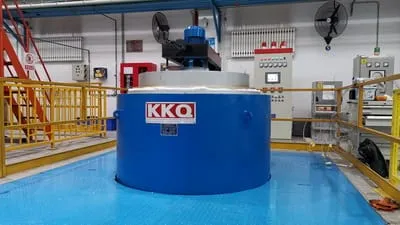
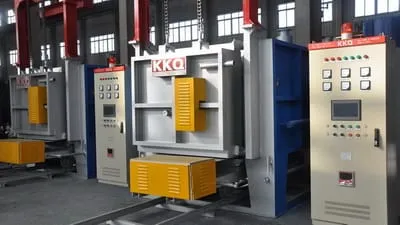
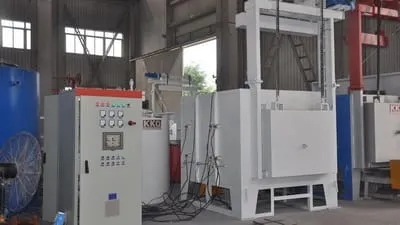
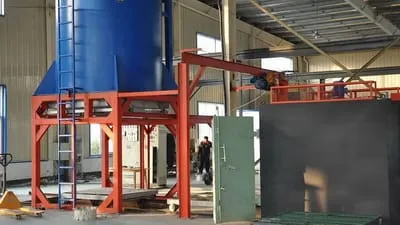
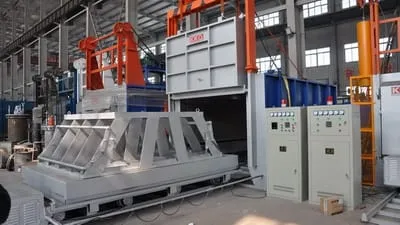

It collects on-site industrial furnace cases across the country
Hankou Furnace boasts 50 years of manufacturing experience

HKFurnace Wechat