


Process Flow Sampling (check technical conditions, quantity) → Identify material → Determine Quenching operation method → Select fixtures, bind iron wire → Dry → Heat → Cool → Clean oil stains → Tempering → Sandblast → Prevent rust → Straighten → Inspect → Hand over.
1. Equipment : Medium-Temperature Salt Bath Furnace , the composition ratio and application scope of commonly used salt baths are shown in the table below
2. The heating methods are as follows:
a. For general parts, charge the parts directly into Quenching for heating after drying.
b. When parts are heated in a salt bath, suspension method shall be adopted, and appropriate clearance shall be maintained between parts; In addition, the distance between a part and the electrode shall not be less than 30 mm; The distance between a part and the salt bath surface shall not be less than 50 mm; Parts shall be insulated from the ground.
1. Cooling medium, its composition and working temperature are shown in the table below:
2. Comparison of cooling medium capabilities (mass fraction) at 650°C, 10% NaCl aqueous solution > 50% NaOH aqueous solution > lye at around 180°C > diesel oil > engine oil > nitrate salt at around 180°C > nitrate salt at around 280°C.
3. Cooling Method:
a. Single liquid Quenching : The workpiece is only immersed in one coolant and cooled to the bottom.
b. Pre-Cooling Quenching : The workpiece is properly cooled in air before being immersed in the coolant to reduce thermal stress.
c. Dual Liquid Quenching : The workpiece is generally first immersed in water for cooling. After it cools down to near the starting transformation point of martensite, it is immediately taken out and immersed in oil for slow cooling. The cooling time in water is generally calculated as 3-5mm/s according to the effective thickness of the workpiece.
d. Martempering : The workpiece is first immersed in Martempering molten salt for cooling, its residence time is generally 1/3-1/2 of the total heating time, and finally it is taken out and cooled in air.
e. Hot bath Quenching : The workpiece is only immersed in nitrate salt or alkali at 150-180°C for cooling, the residence time is equal to 1/3-1/2 of the total heating time, and finally it is taken out and cooled in air.
f. Isothermal Quenching : Immerse the workpiece in isothermal molten salt for cooling. The temperature and residence time in the molten salt are determined according to the austenite isothermal transformation curves of various different steel grades, and the residence time should be maintained until the austenite transformation is completed.
Quenching For parts that are prone to cracking such as those with holes, cavities, sharp corners, thin edges, grooves and flanges, and deformable parts such as slender parts, thin plates, thin walls and rings, the quality inspector shall organize the three-in-one team to jointly study measures to prevent quenching cracking and deformation. General operations shall comply with the following principles.
1. Shaft-shaped and long-column workpieces must enter the coolant vertically, and the time must be strictly controlled (some can use the roll quenching method).
2. The plate-shaped workpiece must enter the coolant vertically.
3. The cylindrical thin-walled workpiece must enter the coolant vertically.
4. When cooling a workpiece with a concave surface, place the concave surface face up.
5. If the workpiece has uneven thickness, you should immerse the thicker part first.
1. Tempering shall be performed after general parts cool down to room temperature. Tempering shall be done in time for parts with complex shapes to prevent deformation and cracking.
2. The workpiece of Isothermal Quenching is not Tempering .
1. Process Flow
Raw material retrieval → material inspection → clamping → drying → preheating → heating → cooling → oil (hot straightening) or grading (cleaning) or isothermal (cleaning) → intermediate inspection → Tempering → cleaning → sandblasting → rust prevention → straightening → final inspection.
2. Process Operation
(1) When retrieving the workpiece, clearly check the drawing, count the parts thoroughly, inspect the material, clearly identify the weld position, confirm the Quenching cooling method, and handle with care.
(2) Principles for selecting fixtures:
a. Enable the cutting tool to heat uniformly during the heating process.
b. Thin rods and easily bent cutting tools must be hung.
c. The cutting tool can maintain balance during operation.
d. Select reasonable clamping fixtures according to the heating position of the cutting tool.
f. For tools that cannot be clamped, bind them tightly with iron wire, and make sure that the iron wire is not broken under High Temperature .
(3) Preheat at Medium-Temperature Salt Bath Furnace :
a. Preheating temperature: 800-850℃.
b. Preheating time: 2 to 3 times the heating time of High Temperature .
c. Blank of car planer, allow preheating in Box Type electric furnace, the time is 40-60min.
d. The preheating length of ordinary cutting tools is about 20mm longer than the weld seam.
e. The clamps in the furnace are appropriate at 2-4 clamps.
(4) Heating in High Temperature salt furnace:
Heating temperature:
1270-1300℃(W18Cr4V)
1220-1250℃(W6Mo5Cr4V2)
1250-1270℃(W9Mo3Cr4V)
(5) The cooling method is as follows:
a. Oil cooling: Suitable for tools with simple welding shapes, such as turning tools, planing tools, cutter heads and tools that require heat straightening. Method: Take the tool out of the High Temperature salt furnace, perform appropriate oil cooling, then quench it into anhydrous oil, cool it to about 450°C and take it out of the oil.
b. Grading: Suitable for general cutting tools. Method: After the cutting tool is taken out from the salt furnace High Temperature , it is placed in a grading salt furnace to stay, the staying time is equivalent to the heating time, then air-cooled, the grading temperature is 550-600℃.
c. Isothermal heating: Suitable for slender rod-shaped easily bendable cutting tools, slotting cutters, and cutting tools with complex shapes that are extremely prone to deformation or cracking. Method: After taking out from the graded salt bath, place it in an isothermal furnace and hold for 2-3h, the isothermal temperature is (280±10)℃.
d. Notes:
① Cutting tools must be cooled to room temperature before they can be cleaned.
② For easily deformed graded cutting tools, they shall be unloaded promptly after cleaning.
③ The cutting tool after Quenching shall be handled with care to avoid collision damage and chipping.
(6) Tempering : Conducted in Nitrate Salt Furnace .
a. Tempering Temperature (560±10)℃, furnace temperature must be calibrated before formal Tempering .
b. Time: Timing starts after the instrument reaches the temperature. Tool clamping: 30min, Barrel loading tooling: 60-90min.
c. Tempering method, for general cutting tools, they are loaded into Tempering barrels or layered Tempering frames. For small and short cutting tools (taps, forming turning tools, end mills, etc.), when the barrel loading Tempering method is used, a core needs to be added in the barrel. Core specification: Ф100mm×500mm. Tempering barrel specification: Ф400mm×500mm. Deformable rod-shaped cutting tools should use hanging Tempering ; deformable sheet-shaped cutting tools should use Tempering Fixture .
d. Tempering Frequency: For general cutting tools, three times; for isothermal cutting tools, four times. The tool must be fully cooled to room temperature before Tempering .
e. Notes:
① Graded or oil-cooled tools shall Day be Tempering .
② After Tempering , the operator shall notify the Metallographic Examination Tempering level.
③ For those confirmed as having insufficient Tempering , Tempering needs to be performed again.
f. High Speed Steel adopts a new Tempering process (machine saw blade) W9Mo3Cr4V: 1280℃×40s, 560×1h; W18Cr4V: 1310℃×20s, 560×1h; increase Quenching temperature, shorten the holding time, refine High Speed Steel grains, dislocation martensite appears in the structure, changes the original single twinned martensite structure, reduces the relative content of twinned martensite, can improve the strength of High Speed Steel Toughness .
g. Procedures for deoxygenation operations
①Deoxidization temperature: High Temperature furnace: around 1280℃; medium temperature furnace: 880-900℃
② Deoxidizer: purchased finished deoxidizer.
③ Amount added each time: 1kg
④ High Temperature After the first deoxidation of the furnace, send the sample for inspection, test the oxide content: w(BaO) 0.5% w(FeO) 0.5%
⑤ When performing deoxidation operation, turn off the fan, slowly add the deoxidizer and stir. Production can only be carried out after 10 minutes of deoxidation.
(7) High Temperature Temperature measurement of salt bath furnace
a. Quenching The furnace temperature shall be calibrated by the instrument technician with standard instruments before
b. Metallographic calibration furnace temperature, metallographic test block: Ф10mm×15mm, heating time: 2min.
(8) Use of thyristors
a. Check whether all parts of the instrument are normal before starting.
b. Manually close when starting, the current controlled by the thyristor shall not exceed 10A, and the primary current of the voltage regulator shall not exceed 150A.
c. The maximum current of the voltage regulator during long-term operation is 220A
d. When adjusting the temperature Liter , manually control the current to not exceed 15A.
e. When working normally, it should be closed Automatic
f. For convenient operation, High Temperature should be used first during work, then gradually lower the temperature for use.
(9) Adjustment of salt bath composition
a. Regularly analyze the salt bath composition, generally twice a month, adjust and supplement the salt bath composition according to the analysis results.
b. Regularly analyze the oxide content in the salt bath, increase or decrease the number of deoxidization times according to the test results. Medium temperature furnace: once a month; High Temperature furnace: twice a month.
c. The water content in nitrate salt and alkali baths has a great influence on the cooling capacity of parts. The water content w(H₂O) of graded nitrate salt tanks and alkali tanks is 6%.


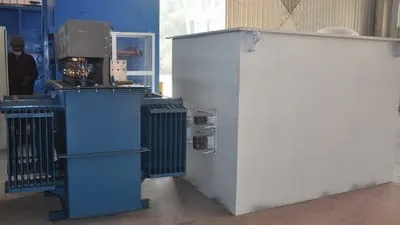
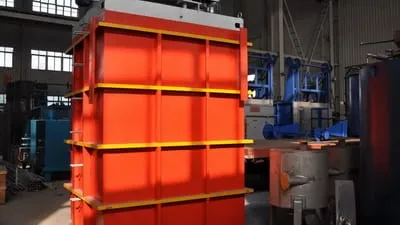

It collects on-site Salt Bath furnace cases across the country
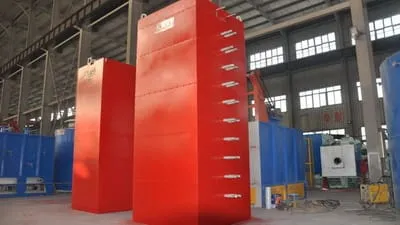
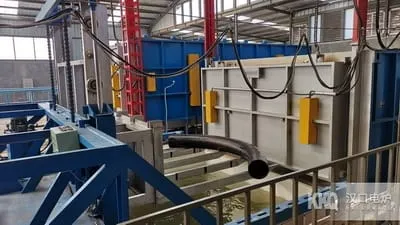
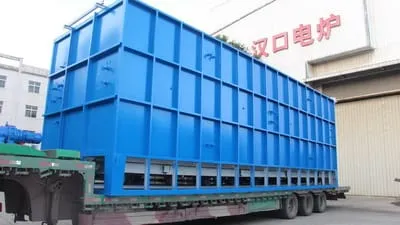
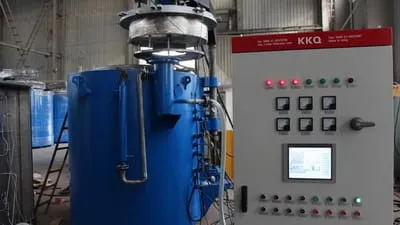
Hankou Furnace boasts 50 years of manufacturing experience


HKFurnace Wechat